

Every May, the same thing happens across Santa Clara.
The weather turns gorgeous. People open windows to let in the breeze. And then, sometimes overnight, the air shifts. A fire ignites somewhere in the hills — or two hundred miles away in the Central Valley — and by morning the sky has that familiar pale-yellow tint. Your phone buzzes with a Bay Area Air Quality Management District alert. The AQI climbs past 100. You shut the windows, brew some coffee, and figure you’re safe inside.
Here’s the thing most people don’t find out until it’s too late: closing your windows doesn’t actually protect you from wildfire smoke. Not if your HVAC system isn’t equipped to handle it.
We’ve been doing HVAC work in Santa Clara County since 1984, and every wildfire season we get the same calls — homeowners with watery eyes and smoke smell inside their house who did everything “right.” Windows closed. Doors sealed. AC running. And still, the air quality inside their home is terrible.
The culprit, almost every time, is the filter.
The Problem with “Just Stay Inside”
Wildfire smoke is made up of particles called PM2.5 — fine particulate matter that measures roughly 2.5 microns or smaller. For comparison, a human hair is about 70 microns wide. These particles are small enough to slip through gaps around door frames, through the return air vents on your HVAC system, and right past a standard 1-inch filter like it isn’t there.
The standard fiberglass filters that come with most systems — the cheap ones you grab at the hardware store — are typically rated MERV 1 to 4. They’re designed to protect your equipment from large dust and debris. They do essentially nothing for the fine particles in wildfire smoke.
Even the common upgrade, a MERV 8 filter, falls short during a real smoke event. Homeowners across the South Bay have noticed this firsthand: windows shut, doors sealed, and by afternoon their eyes are burning and the air smells like a campfire. That’s because their HVAC is cycling the same compromised indoor air through a filter that was never built for this kind of pollution.
The result is that your heating and cooling system, which runs for hours every day, can actually distribute smoke particles to every room in the house faster than outdoor infiltration would on its own. It’s a frustrating situation — your system is working hard, and it’s making things worse.
What Actually Works: Whole-Home Filtration
The good news is that the solution isn’t complicated, and it doesn’t require ripping out your existing system. It’s about pairing your HVAC with the right air filtration — specifically, one built for the conditions we actually live with here in the South Bay.
This is where the Lennox Healthy Climate filtration system stands out. As an authorized Lennox dealer, it’s one of the systems we install and recommend most often for Santa Clara homeowners who want real protection — not just a marginal upgrade.
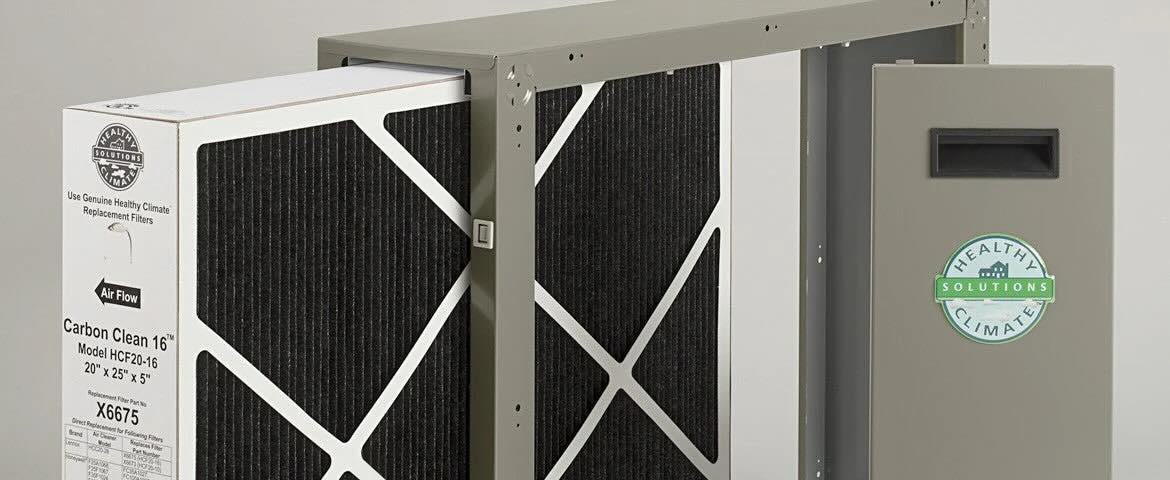
The Healthy Climate line includes media air cleaners rated at MERV 11, MERV 13, and MERV 16 — the highest MERV rating available for residential whole-home filtration. The top-tier option, the Carbon Clean 16, combines that MERV 16 rating with activated, carbon-coated fibers. What that means in practice:
- Captures over 95% of particles in the 0.3–1.0 micron range — which is exactly where PM2.5 wildfire smoke particles land
- The activated carbon layer absorbs smoke odors and VOCs (volatile organic compounds), not just the particles themselves
- Reduces ground-level ozone inside your home by up to 50%, which matters because ozone can drift indoors from smoky outdoor air
- Produces zero ozone emissions of its own — an important distinction, since some electronic air cleaners generate ozone as a byproduct, which is itself a lung irritant
- The filter typically only needs to be replaced once a year under normal conditions — though during a heavy smoke season, we recommend checking it more often
It’s worth noting: California’s Title 24 code now requires MERV 13 or higher for new HVAC installations. So if you’re in Santa Clara and your system is newer, there’s a good chance the infrastructure for proper filtration is already in place. The question is whether the filter living inside it is actually up to the job.
Why the System Pairing Matters
One thing that surprises homeowners is that you can’t just stuff a higher-rated filter into any cabinet and call it done. A thicker, denser filter that your system wasn’t designed for will restrict airflow, work your blower motor harder, and can actually reduce how effectively air circulates through your home.
The Lennox Healthy Climate system is engineered around this problem. Its deep-pleat design allows the filter media to capture far more particles than a flat filter while maintaining the airflow your system needs to run efficiently. That balance — serious filtration without choking the system — is harder to achieve than it sounds, and it’s why whole-home IAQ works best when the filter and HVAC equipment are properly matched.
This is something our technicians at Bellows assess before recommending anything. We look at your existing system, your ductwork, your cabinet size, and your household’s specific needs — whether that’s severe allergies, young children, elderly family members, or just a general desire to not breathe smoke in your own living room. The recommendation comes after that conversation, not before it.
When installed correctly in a compatible system, the Healthy Climate setup integrates cleanly into your existing ductwork, requires no separate power source, and runs quietly in the background doing its job every time your HVAC cycles. During wildfire season in a neighborhood like Santa Clara — where smoke from fires as far away as Shasta County can drift in on northeasterly winds — that kind of all-day passive protection matters.
A Few Things You Can Do Right Now
Even before you talk to anyone about a filtration upgrade, there are steps worth taking as wildfire season kicks off in May:
Check your current filter’s MERV rating. Pull out the filter and look for a rating printed on the cardboard frame. If it says MERV 8 or lower, it isn’t doing much during a smoke event.
Switch your thermostat fan to “ON” instead of “AUTO.” Most people leave their systems on auto, which means the fan only runs when the system is actively heating or cooling. Setting it to “on” keeps air continuously circulating through your filter — which meaningfully increases how many times indoor air gets cleaned per hour during a smoky day. It uses a bit more electricity, but during an active smoke event, it’s worth it.
Don’t ignore smoke odors inside the house. If you’re smelling smoke with the windows shut, your current filtration isn’t cutting it. That’s not a minor annoyance — PM2.5 particles have been linked to respiratory issues, cardiovascular stress, and worsened symptoms for anyone dealing with asthma or allergies.
Think about your ducts, not just your filter. Older homes in Santa Clara often have aging ductwork with small gaps and leaks that pull unfiltered air directly from attic spaces or crawlspaces. No filter in the world compensates for a duct system that’s pulling in outside air around the filter entirely. If your system is more than 15 years old, it’s worth having someone take a look.
Ask about the full system, not just the filter. If your HVAC is aging or you’re due for a replacement, this is the moment to have the conversation about whole-home air quality as part of the project, not an afterthought. A well-matched system — good equipment paired with proper filtration like the Lennox Healthy Climate — will serve you through fire seasons for years.
What the BAM! Maintenance Plan Covers (And Why It Matters for Air Quality)
One thing we see constantly: homeowners who invested in quality filtration but never had it checked. A clogged MERV 16 filter is worse than a fresh MERV 8 one, because the airflow restriction builds up over time and your system starts working around it — sometimes pulling air through gaps rather than through the filter at all.
This is part of why we offer the Bellows Annual Maintenance (BAM!) plan — a membership program designed to keep your HVAC, plumbing, and electrical systems running the way they’re supposed to. For your heating and cooling system, that includes:
- Annual inspections before the summer cooling season kicks in
- Filter checks and replacements
- Priority scheduling — so when you call in June because the smoke is bad and you want someone to look at your system before the weekend, you’re not waiting two weeks
- Discounted pricing on any repairs that come up
A clean, well-maintained system with the right filtration is your best defense against wildfire smoke. A neglected one is just recirculating the problem.
About Bellows: 40+ Years Serving Santa Clara County
Bellows Plumbing, Heating, Cooling & Electrical has been a family-owned business since 1984. We’re based right here in the Bay Area — not a national franchise dispatching technicians who don’t know the difference between a Santa Clara Valley summer and a San Jose winter.
Our HVAC team serves homeowners throughout Santa Clara and San Mateo Counties, including San Jose, Sunnyvale, Campbell, Mountain View, Cupertino, Los Gatos, Palo Alto, Saratoga, Milpitas, and the surrounding communities. Every technician we send to your home has been background-checked, drug-tested, and trained on the equipment they’re working on. We hold California CSLB license #483881 and carry full liability insurance and workers’ comp coverage.
We’re also an authorized Lennox dealer, which means when we install a Healthy Climate filtration system, we’re doing it to factory specifications with the warranty intact — and we’re around to service it when you need us.
The Bottom Line
Santa Clara sits in a part of California where wildfire smoke isn’t a once-a-decade event anymore. It’s a May-through-October reality that some years runs longer. The Bay Area’s geography — those temperature inversions, the easterly winds off the Central Valley — means smoke doesn’t have to come from nearby to affect your air quality.
The technology to handle this at the whole-home level exists, it’s not prohibitively expensive, and it works. Lennox’s Healthy Climate Carbon Clean 16 is one of the better examples of what serious residential air filtration looks like — not a portable purifier you drag from room to room, but a system that treats every cubic foot of air moving through your home, around the clock, without you having to think about it.
If you’re not sure what’s inside your system right now, this is a good time of year to find out.
Ready to get your home ready for wildfire season?
Call Bellows at 408-866-4620 or book online at bellowsservice.com. We offer free estimates on HVAC replacements, and our comfort advisors will walk you through your options without pressure. Same-day service is often available for Santa Clara County homeowners.