
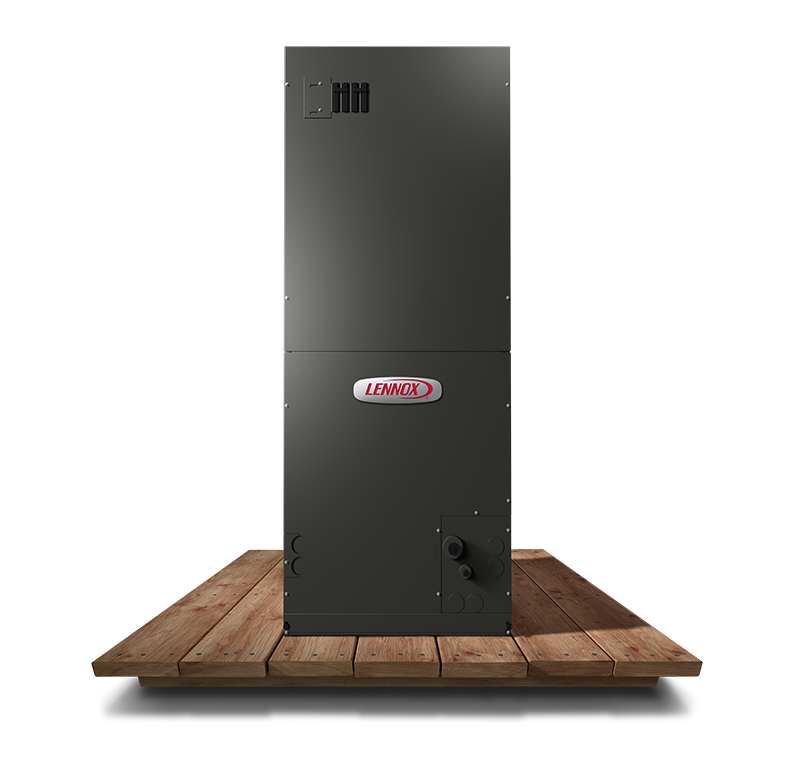
If you’ve been thinking about ditching your gas furnace and going all-electric with a heat pump, you’ve probably run into the same roadblock thousands of homeowners hit every year: the air handler won’t fit.
The air handler is the indoor half of a heat pump system — it replaces your furnace and moves conditioned air through your ductwork. Until recently, most air handlers were significantly taller and often wider than the furnaces they were meant to replace. That meant tearing into closets, reframing utility spaces, or modifying ductwork just to make the upgrade work. For a lot of homeowners, that was enough to kill the project before it started.
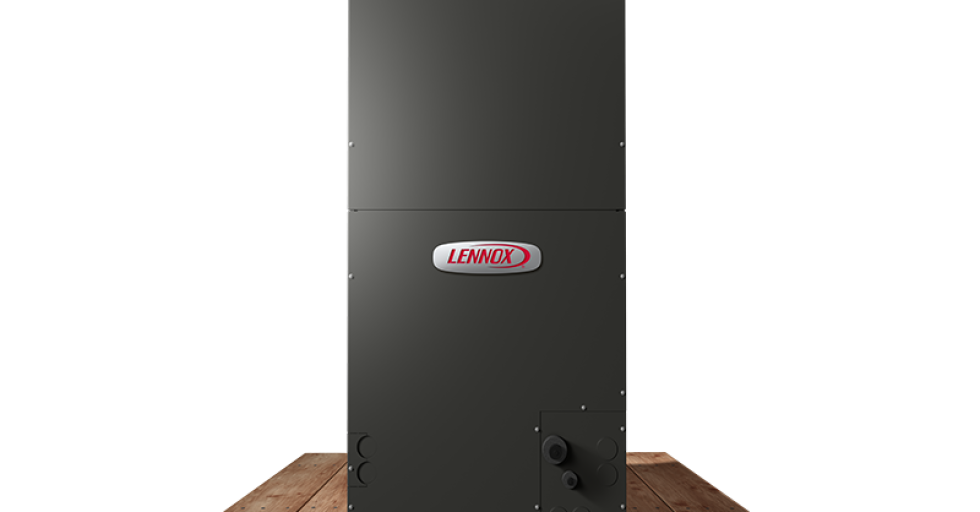
Lennox’s new CBK43UHET changes that.
Smaller cabinet, bigger possibilities
The CBK43 is Lennox’s new R-454B air handler in the MERIT® Series, and the headline feature is its compact cabinet. Compared to the previous generation CBK45, the CBK43 shaves several inches off every size in the lineup. A 3-ton CBK45 stands about 53.6 inches tall — the equivalent CBK43 is just 43.5 inches. The 1.5, 2, and 2.5-ton models are all just 41.5 inches tall. That’s a serious reduction, and it’s the difference between “we can’t make this work” and “let’s get it scheduled.”
For tight closets, low-clearance attics, garage corners, and crawl spaces, this opens up retrofits that simply weren’t possible before.
Pairs perfectly with Lennox slim-cabinet heat pumps
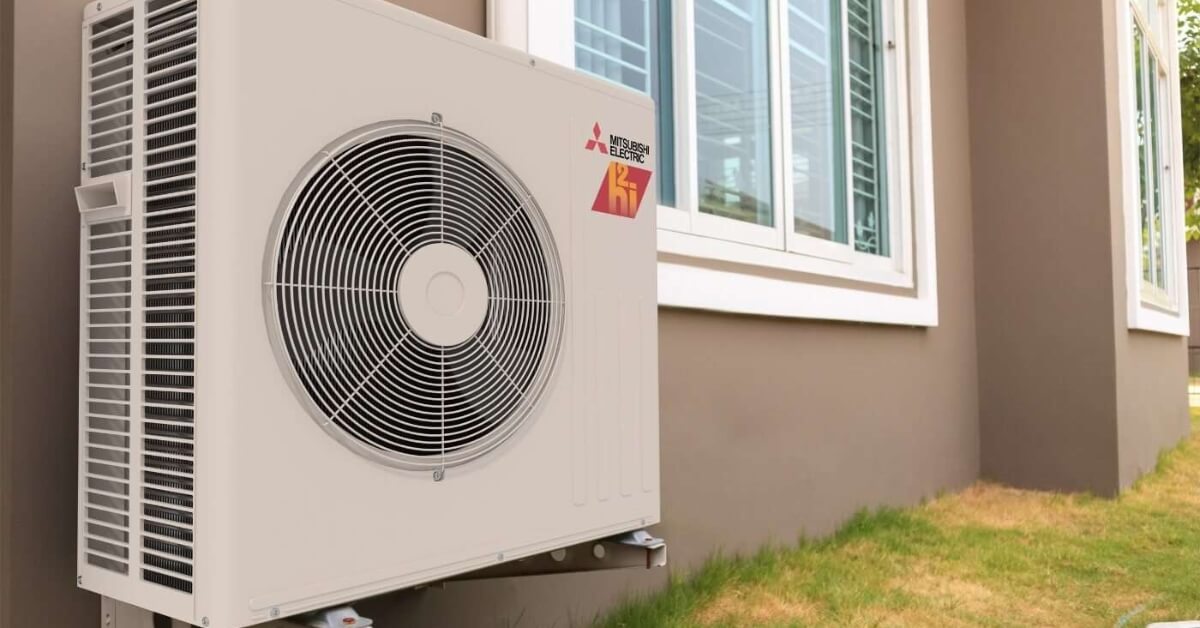
The CBK43 is a natural match for Lennox’s slim-cabinet, inverter-driven heat pump condensers like the EL18KSLV and the ML15KSLV. Both of those outdoor units are quiet, efficient, and designed to fit in tight side yards — which matches the spirit of what the CBK43 is doing on the inside. You end up with a complete heat pump system that fits into more homes, runs quieter, and modulates its output for better comfort and lower bills.
Dual voltage: 240V or 120V
Here’s the other feature that’s going to save homeowners real money: the CBK43 can run on either a 208/230V circuit or a standard 115V circuit. Conversion is a simple plug change inside the unit — pull the 230V plug, snap in the 115V plug that ships with the unit, and you’re done.
Why does this matter? Because in a lot of furnace-replacement scenarios, the existing circuit feeding your furnace is 120V. If your new air handler can run on that same circuit, you don’t have to pay an electrician to run a new 240V line back to your main panel. For homes with full electrical panels (a real issue in older Bay Area housing stock), this can be the difference between a clean swap and a much more expensive project that includes a panel upgrade.
Note: if you want to add electric heat strips for backup or supplemental heating, those still require 208/230V — but for a lot of mild-climate Bay Area homes paired with an efficient heat pump, you may not need them at all.
What else is good about it
A few other things worth calling out:
- 9-speed Power Saver constant-torque blower motor — easy DIP switch adjustments to dial in airflow for your specific ductwork.
- R-454B refrigerant — the new lower-GWP refrigerant standard, with a built-in refrigerant detection system for safety.
- Upflow, horizontal, and (with kit) downflow orientations — flexible for closets, attics, garages, and basements.
What this looks like in the real world
Bay Area homes don’t fit the national average. There are no basements, no dedicated mechanical rooms, and very few homes built with HVAC retrofit in mind. Here are the scenarios we run into constantly — and where the CBK43 finally gives us a real answer.
The hall closet furnace in a San Jose tract home. Thousands of ranch-style homes built across Santa Clara County in the 1950s through 1970s were built with the furnace crammed into a small hallway closet — sometimes barely 24 inches deep and 36 inches wide, with the ductwork running straight up into a shallow attic. The previous-generation air handler was simply too tall to stand upright in that space without cutting into the ceiling or the attic floor above. The CBK43’s 41.5-inch height on the 1.5 to 2.5-ton models fits into closets that were previously off-limits.
The low-ceiling garage in a Marin or Sonoma County ranch. A lot of single-story homes in Marin and Sonoma have the furnace in the garage, typically tucked into a corner with a low soffit or fire-rated drywall ceiling above it. Garage height is often the limiting factor — and when the ceiling is at 7 feet and the existing furnace is 56 inches tall with a plenum and ductwork connection above it, you’re already tight. A previous-generation air handler often couldn’t replace it without dropping the ductwork connection or fighting with overhead obstructions. The CBK43 cuts that profile substantially and makes those garage installs clean and straightforward again.
The slab-on-grade new build in a San Mateo or Santa Cruz HOA development. Newer construction in the Bay Area is increasingly slab-on-grade — no crawl space, no attic access worth mentioning, and HVAC equipment tucked into a small interior utility alcove shared with the water heater. HOA restrictions often prevent exterior equipment from being placed anywhere visible, which limits where the outdoor condenser can go. These setups demand compact, versatile indoor equipment. The CBK43’s ability to run in upflow or horizontal orientation, combined with its smaller footprint, is exactly what these jobs need.
The Eichler or mid-century home with radiant heat and no existing ductwork. This is one of the trickiest scenarios in the Bay Area. Eichlers and similar mid-century homes were built with radiant floor heating and no forced-air ductwork at all. Homeowners who want to add cooling — or replace the radiant system entirely — are starting from scratch. The ductwork typically has to be routed through interior walls or a very shallow attic, which limits the size of equipment that can be placed at the air handler location. The CBK43’s compact size and flexible orientation options make it a viable anchor point for these from-scratch duct designs in a way that bulkier units simply aren’t.
The peninsula townhome or condo with a shared mechanical closet. In higher-density housing across San Mateo County, Mountain View, and Sunnyvale, the HVAC system often lives in a shared mechanical closet with the water heater, electrical panel, and sometimes the laundry hookups — all in a space the size of a large bathroom. Every inch matters. The CBK43’s compact cabinet means you’re not sacrificing access to the panel or the water heater to make the air handler fit.
In all of these cases, the math is the same: a smaller indoor unit means fewer homeowners have to be told “no.” It means fewer jobs that require expensive structural modifications before the HVAC work can even begin. And it means more Bay Area households can make the move away from gas on a timeline and budget that actually works for them.
Ready to make the switch?
If you’re a homeowner in Marin, Sonoma, Santa Clara, San Mateo, Santa Cruz, Monterey, or San Benito County and you’ve been waiting for the right moment to move to a heat pump, this is it. The CBK43 removes one of the biggest physical barriers to retrofitting, and the dual-voltage feature can take a real chunk out of the installation cost.
We’re stoked to have the CBK43 as part of what we offer our North Bay and South Bay clients. Heat pumps cool just as well as they heat — and when summer hits, you’re going to be a lot more comfortable than you were last year.
Reach out and let’s talk about whether a CBK43-based system is right for your home. Call us at 877-477-7151 or schedule here: https://www.bellowsservice.com/