

What to Look for in a Heat Pump or AC Condenser: A Marin County Homeowner’s Guide
Most people shopping for a heat pump or air conditioner get handed a proposal with a brand name, a tonnage, and a price. That’s about it. Then they try to compare three of those side by side and wonder why the numbers are all over the place.
The spec sheet actually tells you a lot — if you know which four or five lines matter. Here’s what we walk Marin homeowners through before we put anything on paper.
1. Efficiency: SEER2 Is the MPG of Your HVAC System
SEER2 is the easiest place to start because the analogy is almost perfect. It’s the miles-per-gallon of your cooling system. Higher number, less electricity burned to move the same amount of heat.
A builder-grade single-stage unit might land around 14–15 SEER2. A good variable-speed inverter system runs 18–20+ SEER2. On the heating side, you’ll see HSPF2 — same idea, measured for heat pump heating instead of cooling.
Here’s the part the ratings don’t tell you. SEER2 is a seasonal average measured under lab conditions. What actually drives your bill in Marin is how the unit behaves at part load, and we spend most of the year at part load here. Fairfax and San Anselmo don’t need full-blast cooling in June — they need a system that can idle at 30% capacity for six hours without cycling on and off.
That’s the real argument for inverter-driven equipment. A single-stage condenser has two settings: off, and everything it’s got. An inverter modulates. It runs long and slow, which uses less power, holds temperature tighter, and pulls more humidity out of the air. It’s also the reason inverter units are so much quieter — which brings us to the thing most people underestimate.
2. Sound: The Spec Most Homeowners Ignore Until It’s Too Late
Every outdoor condenser makes noise. The question is how much, and who has to listen to it.
Two audiences here. The first is you. If the condenser sits under a bedroom window or next to the patio where you eat dinner, a 72 dB unit will get old fast. The difference between a 72 dB condenser and a 55 dB condenser is not “a little quieter” — decibels are logarithmic, so that gap is dramatic. Modern inverter units routinely rate in the low-to-mid 50s, and some indoor units run under 25 dB.
The second audience is your neighbor’s property line, and this is where Marin gets specific. Noise limits here aren’t set at the county level for every address — Fairfax, San Rafael, Mill Valley, Larkspur, Corte Madera, Ross, Tiburon, and Novato each carry their own municipal noise standards, and unincorporated Marin falls under the County’s own code. Limits for continuously operating mechanical equipment commonly land somewhere in the 45–55 dBA range measured at the property line, and many jurisdictions drop that limit further during overnight hours.
Why this matters practically: a loud unit doesn’t just annoy people, it can restrict where you’re legally allowed to put it. A condenser rated at 70 dB may need to sit a long way from the line to comply. A unit rated in the mid-50s can often go much closer. On the narrow lots common in Fairfax, San Anselmo, and older parts of San Rafael, that distance requirement can eliminate every viable location on the property.
So the sound rating isn’t a comfort feature. It’s a placement constraint. Pick the equipment and the location together, not one and then the other.
A few things that make sound worse regardless of the rating: tucking a unit into a tight alcove or an inside corner where two walls meet, mounting it on a hollow deck or a wall that acts as a drum, or putting it where fences and stucco bounce sound straight back at a neighbor. A good installer looks at reflective surfaces before picking a pad location.
3. Space and Placement: Square Isn’t Your Only Option Anymore
The classic AC condenser is a big square box with the fan pointing at the sky. It needs open air above it, real clearance on the sides, and a level pad. On a lot of Marin properties — hillside homes in Fairfax, tight side yards in Kentfield, houses built right up to a setback — that flat open square of ground simply doesn’t exist.
That’s where slim-profile side-discharge units come in. The fan sits on the front face instead of the top, the cabinet is narrow front-to-back, and the whole thing can mount to a wall bracket instead of a ground pad. Because these are almost always inverter-driven, you get the efficiency and the low sound rating in the same package.
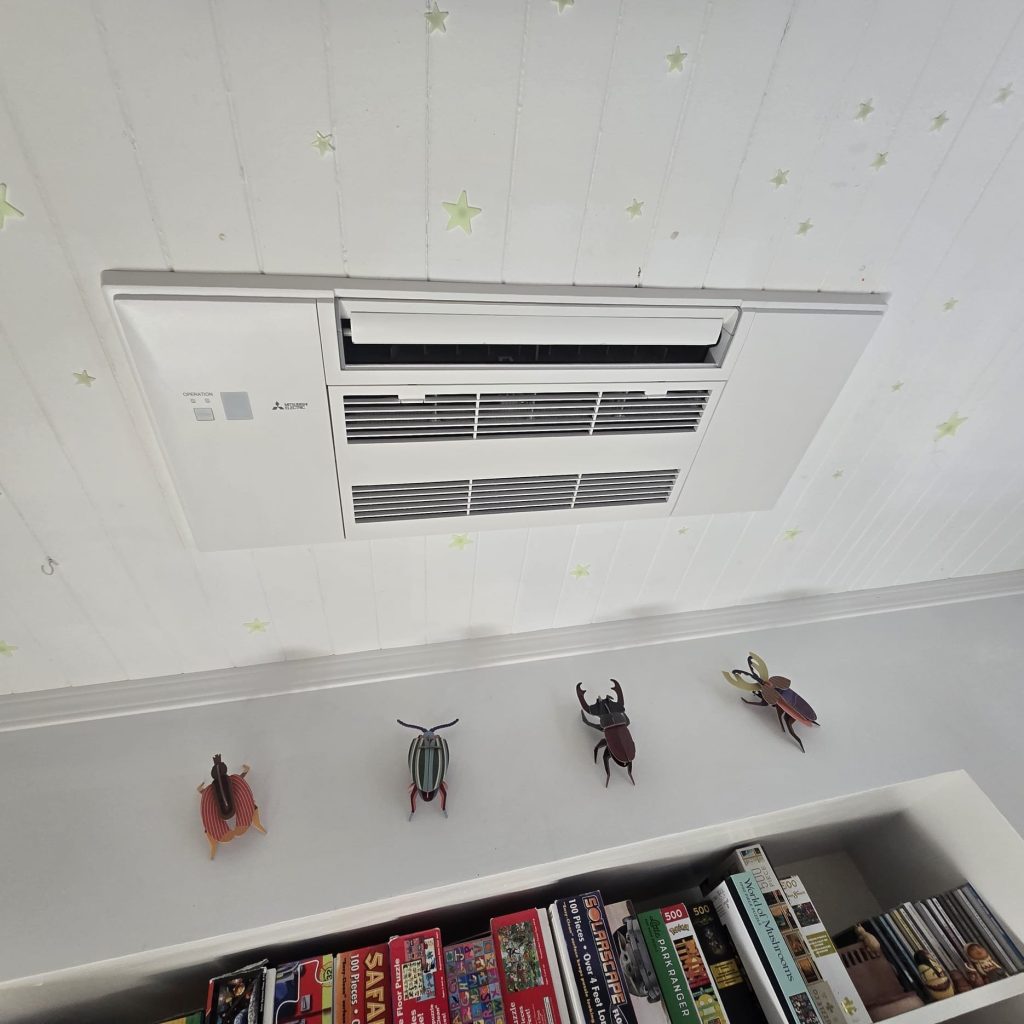
A recent Fairfax install shows exactly how this plays out. On a home on Willow Avenue, there was no good flat spot for a traditional outdoor unit — the usable ground just wasn’t there. We used a slim side-discharge heat pump mounted on a bracket directly to the side wall of the house, ran the lineset up in a clean guard, and paired it with a Mitsubishi flush ceiling-mount cassette air handler inside. The indoor unit sits nearly flat with the ceiling. If you weren’t looking for it, you’d take it for a vent.
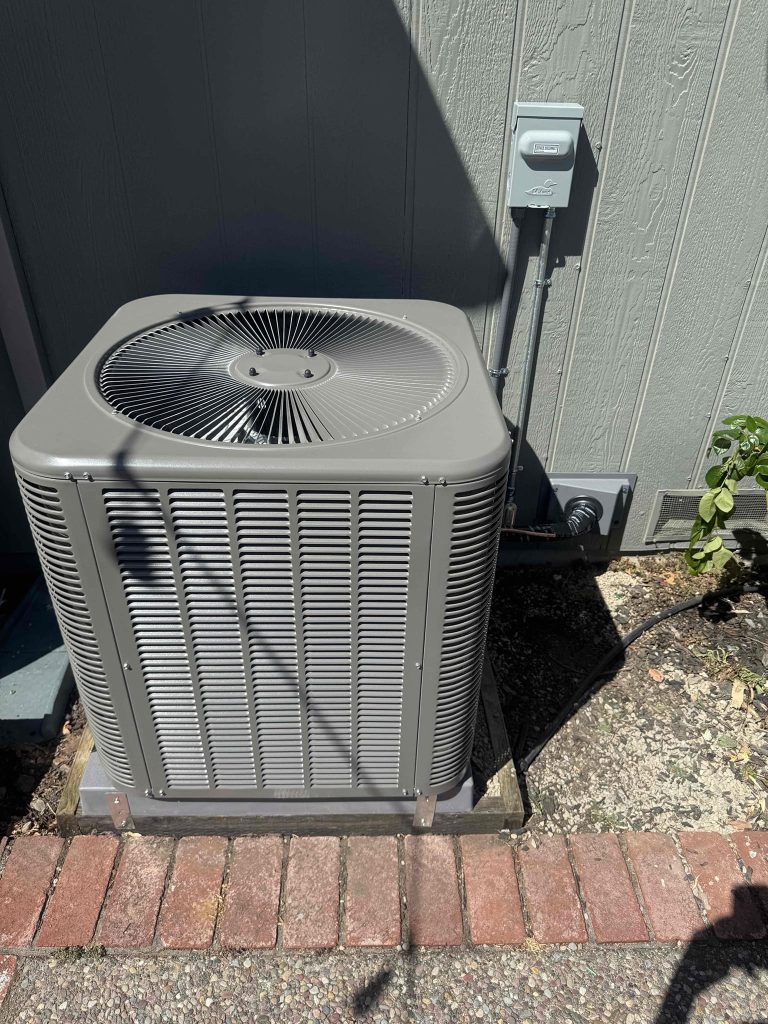
Compare that to a San Rafael project where we added cooling to a home’s existing furnace. That house had the space, the ductwork was in good shape, and the homeowner wanted straightforward AC. Traditional top-discharge condenser on a pad next to the house, tied into the existing air handler and disconnect. Right tool, right house.
Neither one is the “better” system. They solve different problems.
4. Make and Model: Where the Details Bite
Once you’re past efficiency, sound, and shape, the specific model number starts to matter in ways that don’t show up in a sales pitch.
Lineset length and lift. Every system has a maximum refrigerant line length and a maximum vertical rise between the indoor and outdoor units. Some systems top out around 65 feet of piping, others allow 100 feet or more with a 50-foot height difference. If your condenser has to go on the far side of the house, or down the hill from a Mill Valley home built into a slope, that number decides which equipment is even eligible. Exceed it and you lose capacity, or you void the warranty.
Electrical requirements. Every model lists a minimum circuit ampacity and a max breaker size. Older Marin homes frequently have 100-amp panels that are already full. Sometimes the fix is a smaller-draw inverter unit; sometimes it’s a subpanel or a service upgrade. Either way, it’s better to find out during the estimate than on installation day.
Refrigerant type. The industry has moved to lower-GWP refrigerants like R-454B. It’s worth knowing what’s in the system you’re buying and confirming your contractor is set up to service it.
Cold-weather output. Heat pump capacity drops as it gets colder outside. If you’re replacing a gas furnace with a heat pump, look at rated capacity at 17°F, not just at 47°F. Marin winters are mild, but the rating tells you how much margin you’ve got.
Coastal corrosion. If you’re anywhere near the water — Sausalito, Tiburon, Corte Madera’s bay edge — salt air eats aluminum fins. Several manufacturers offer corrosion-coated coils rated for far longer salt-spray exposure. We also offer custom coating sprays.
Parts and service. A great unit nobody local can get parts for is a bad unit. That’s why Bellows has fostered strong relationships with brands we stand behind like Lennox, Mitsubishi, Quit, and Goodman. We can usually gets parts the very next day if needed.
A Few More Things Worth Asking About
- Load calculation. Ask whether the proposal is based on an actual block load calc or on “what was there before.” Oversized equipment short-cycles, runs loud, and dehumidifies poorly.
- Ductwork. A high-SEER2 condenser bolted to leaky ducts is money thrown away. If the ducts are 40 years old, address them.
- Permits and Title 24. California requires a permit for this work, and changeouts generally trigger Title 24 compliance — which can mean duct leakage testing and refrigerant charge verification by a third-party HERS rater. A quote that doesn’t mention permitting isn’t a complete quote.
- Rebates and incentives. MCE is the program still open to Marin homeowners. BayREN’s heat pump rebates ended in April 2024, and the statewide programs, TECH Clean California and HEEHRA, are both fully reserved. Ask what is actually available for your address before you sign.
- Warranty registration. Most manufacturers require registration within a set window to get the full parts warranty. Confirm who’s handling it.
Frequently Asked Questions
What’s a good SEER2 rating for a home in Marin County?
For most Marin homes, 16–18 SEER2 is a solid mainstream target, and inverter systems in the 18–20+ range make sense if you run the system a lot or want the quietest, most consistent operation. Because our cooling season is moderate, the part-load behavior of an inverter often matters more to your bill than the headline SEER2 number.
How loud is too loud for an AC unit in Marin?
It depends on your specific city or town — Marin’s jurisdictions set their own limits, and many restrict continuous mechanical equipment noise at the property line to roughly the 45–55 dBA range, with stricter overnight limits. Check with your local planning or building department, or ask your contractor to verify before equipment is selected.
Can a heat pump be mounted on a wall instead of the ground?
Yes. Slim side-discharge units are commonly wall-mounted on brackets, which is how we handled a recent Fairfax install where there was no suitable flat ground. Wall mounting requires proper structural attachment, vibration isolation, and clearance for airflow and service.
Does a heat pump work with my existing furnace and ductwork?
Often, yes. Many heat pump condensers can be paired with an existing furnace or air handler in a dual-fuel or retrofit arrangement, and many AC condensers tie into an existing furnace the way we did on the San Rafael project. Whether it’s a good idea depends on the age and condition of the equipment and ducts.
Do I need a permit to replace an AC condenser in Marin County?
Yes. Replacement of HVAC equipment requires a permit in California, and Title 24 compliance requirements may apply, including third-party HERS verification of duct leakage and refrigerant charge.
Getting It Right for Your House
The best system on paper isn’t automatically the best system for your address. A slim inverter heat pump is the obvious answer on a tight Fairfax lot with a difficult side yard. A conventional condenser tied to a working furnace is the obvious answer on a San Rafael home with good ducts and room to work.
Bellows Plumbing, Heating, Cooling & Electric has been serving Marin County homeowners for years, and we handle the whole picture — load calculation, equipment selection, noise and placement review, electrical, permitting, and HERS coordination. If you’re weighing options, we’ll walk your property and tell you honestly what fits.
Call our Marin office at 415.460.1264, or reach us Bay Area–wide at 877.477.7151.
AC or Heat Pump Repair & Replacement Experts
Bellows Plumbing, Heating, Cooling & Electric is a full service plumbing company offering replacement, repair, and maintenance for everything under your home’s roof. Whether you’re in San Jose, Santa Clara, Marin, Sonoma, Santa Cruz, or Monterey, our licensed technicians are here to help you build a more comfortable home & workspace. Click here to schedule online.
Marin County
San Rafael · Mill Valley · Novato · Sausalito · Fairfax · San Anselmo · Corte Madera · Tiburon
Santa Cruz County
Santa Cruz · Scotts Valley · Capitola · Watsonville · Aptos · Ben Lomond
Santa Clara County
San Jose · Sunnyvale · Santa Clara · Cupertino · Los Gatos · Campbell · Saratoga
San Mateo County
Palo Alto · Redwood City · San Mateo · Burlingame · Daly City · Half Moon Bay
Sonoma County
Santa Rosa · Petaluma · Rohnert Park · Windsor · Healdsburg · Sebastopol
Napa County
Napa · St. Helena · Calistoga · Yountville · American Canyon
Monterey County
Monterey · Salinas · Carmel · Pacific Grove · Seaside · Marina
San Benito
Hollister · San Juan Bautista · Tres Pinos · Morgan Hill · Gilroy