
A failed water heater is more than an inconvenience — it can flood your utility space, damage flooring, and leave your family without hot water for days. Here’s exactly what to do, what to look for, and how a proper replacement protects your home long-term.
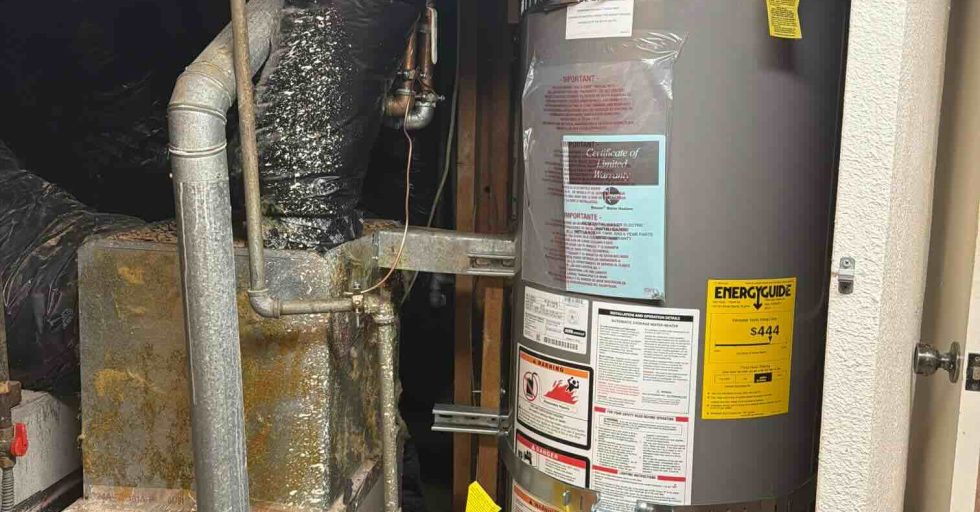
We recently finished a job in Aptos that’s a good reminder of how quickly a water heater failure can go from minor drip to major flood. The homeowner called us after their water heater failed at the bottom of the tank — water poured into the utility closet, soaked the floor, and left a mess that could have been far worse. Our plumber Josh arrived fast, pulled the old unit, raised the installation up off the floor, added a proper drain pan, and installed a new 40-gallon Rheem gas water heater — permitted and done right.
If you’re reading this because something seems off with your water heater, you’re in the right place. This guide walks you through what to do, what the warning signs mean, and what a proper water heater replacement involves.
Step 1: Recognize the warning signs early
Most water heaters don’t fail without warning. The signs are usually there — they’re just easy to ignore until something goes wrong. Here’s what to watch for:
- Rust-colored or discolored hot water — This usually means corrosion inside the tank. When the anode rod wears out, the tank starts rusting from the inside.
- Rumbling or popping noises — Sediment builds up at the bottom of the tank over time, especially in areas with hard water. In parts of Santa Cruz County, Santa Clara, and Monterey, water hardness can be significant. That sediment hardens and forces the heater to work harder, creating noise and accelerating wear.
- Inconsistent water temperatures — If your hot water runs cold unexpectedly or takes much longer to recover, your heating element or thermocouple may be failing.
- Water pooling around the base — Even a small amount of standing water near your water heater is a red flag. Don’t wait.
- Age — Most tank water heaters last 8–12 years. If yours is older, it’s not a question of if it will fail, but when.
Hard water shortens water heater life. In Santa Clara County groundwater areas, hardness can reach extremely high levels — this accelerates sediment buildup and can reduce your water heater’s effective life by 2–4 years. Annual flushing and a water softener can make a significant difference.
Step 2: Shut off the water and gas immediately if you see a leak
If water is actively pooling or spraying, your first move is to stop the flow. Here’s how:
- Turn the cold water supply valve (located on the pipe going into the top of the tank) clockwise until it stops.
- If you smell gas or suspect a gas leak, turn off the gas supply valve at the unit and leave the area. Call your gas company and a licensed plumber immediately — do not try to relight the pilot on your own.
- Turn off the power at your circuit breaker if you have an electric water heater and there is water near electrical connections.
- Clean up standing water quickly to reduce the risk of mold or floor damage.
When in doubt, call first. A licensed plumber can assess the situation quickly and safely. Bellows offers 24-hour service across Santa Cruz, Monterey, Santa Clara, and surrounding counties. A short call can prevent a costly mistake.
Step 3: Assess — repair or replace?
Not every water heater issue requires a full replacement. Here’s a general guide to help you think through the decision:
Repair
Usually makes sense when…
Replace
Usually makes sense when…
Upgrade
Worth considering when…
Step 4: Understand your water heater options
When it’s time to replace, the type of water heater you choose affects your energy bills, hot water availability, and long-term cost. Here’s a plain-language breakdown:
Efficient Electric
Highly efficient, 240V and 115V models available, eligible for significant rebates. Slower recovery but low operating costs. Requires outdoor-ducted space or ample space in the installed location. Are larger in height than their tank water heater counterpart.
Step 5: Make sure the installation is done right
This is where most homeowners get shortchanged. A water heater is only as good as its installation. A proper job includes more than just swapping the unit.
- Permits pulled and inspected — In California, water heater replacements require a permit in most jurisdictions. A permitted install protects you legally, maintains your homeowner’s insurance coverage, and ensures the work meets code. Always ask your contractor if they’re pulling a permit.
- Drain pan installed — The Aptos job mentioned above is a perfect example. A drain pan under the unit with a properly routed drain line means that if the tank ever fails, water drains away instead of flooding your floor. This single step prevents thousands of dollars in water damage.
- Proper elevation — In garages and utility closets, water heaters often need to be elevated to meet code requirements and to reduce moisture exposure at the base of the tank.
- Seismic strapping — Required in California. The tank must be strapped to the wall with approved strapping to prevent tipping during an earthquake.
- Correct gas line sizing — An undersized gas line will starve your water heater of fuel, leading to poor performance and premature failure.
- T&P relief valve and discharge pipe — The temperature and pressure relief valve must be properly installed and piped to discharge safely.
According to Consumer Reports, installation quality matters more than brand choice. A well-installed mid-tier water heater will outlast and outperform a premium unit that was rushed in without permits or proper code compliance.
Step 6: Protect your investment after installation
Once your new water heater is in, a little ongoing maintenance goes a long way. The two most important things you can do:
- Annual flush — Flushing sediment from the tank every year extends its life and maintains efficiency. This is included in Bellows’ BAM (Bellows Annual Membership) plan.
- Water softener — If you’re in an area with hard water (much of Santa Clara County, inland Santa Cruz, Monterey, and San Benito), scale buildup is the single biggest threat to your water heater’s lifespan. A water softener can add 2–4 years to the life of your unit and reduce energy costs at the same time.
Frequently asked water heater questions
Most standard tank water heater replacements take 4-8 hours for an experienced technician. Tankless installs or situations with complicated venting or gas work may take longer, 1 – 2 days. Bellows handles the permit process for you, which can add a few days for inspection scheduling after the install.
Yes, in most cases. Permit requirements vary by jurisdiction but apply throughout Santa Cruz, Monterey, Santa Clara, Marin, Sonoma, San Mateo and surrounding counties. A reputable contractor will always pull the required permit — it protects you, not just them.
For most homes with 2–4 people, a 40–50 gallon tank is standard. Larger households or those with high hot water demand may benefit from a 50–75 gallon tank or a tankless system. A Bellows technician will assess your home and recommend the right size during a free estimate.
Yes — particularly for heat pump water heaters (HPWH). Rebates are available through programs including Central Coast Community Energy (CCCE), Silicon Valley Clean Energy (SVCE), Peninsula Clean Energy (PCE), San Jose Clean Energy, and Marin Clean Energy (MCE). Rebate amounts vary based on your location, existing equipment, and household income. Bellows can walk you through what’s available at your address.
A drain pan is a shallow tray installed beneath your water heater that catches water if the tank leaks or fails. California code requires drain pans in many installations, and for good reason — when a tank fails, a pan and proper drain line can mean the difference between a simple swap and thousands of dollars in water damage. We install them on every job.
Water Heater Replacement & Repair Across 8 Counties
Bellows Plumbing, Heating, Cooling & Electric is a full-service water heater replacement, repair, and maintenance company proudly serving homeowners and small businesses throughout the greater Bay Area and Central Coast. Whether you’re in Marin County or Monterey, our licensed technicians bring the same factory-trained expertise and direct manufacturer relationships to every job.
Marin County
San Rafael · Mill Valley · Novato · Sausalito · Fairfax · San Anselmo · Corte Madera · Tiburon
Santa Cruz County
Santa Cruz · Scotts Valley · Capitola · Watsonville · Aptos · Ben Lomond
Santa Clara County
San Jose · Sunnyvale · Santa Clara · Cupertino · Los Gatos · Campbell · Saratoga
San Mateo County
Palo Alto · Redwood City · San Mateo · Burlingame · Daly City · Half Moon Bay
Sonoma County
Santa Rosa · Petaluma · Rohnert Park · Windsor · Healdsburg · Sebastopol
Napa County
Napa · St. Helena · Calistoga · Yountville · American Canyon
Monterey County
Monterey · Salinas · Carmel · Pacific Grove · Seaside · Marina
San Benito
Hollister · San Juan Bautista · Tres Pinos · Morgan Hill · Gilroy
Same-Day WATER HEATER REPLACEMENT
We get it no hot water is a major drag. Give us a call for a fast same day water heater replacement. Book here www.bellowsservice.com